



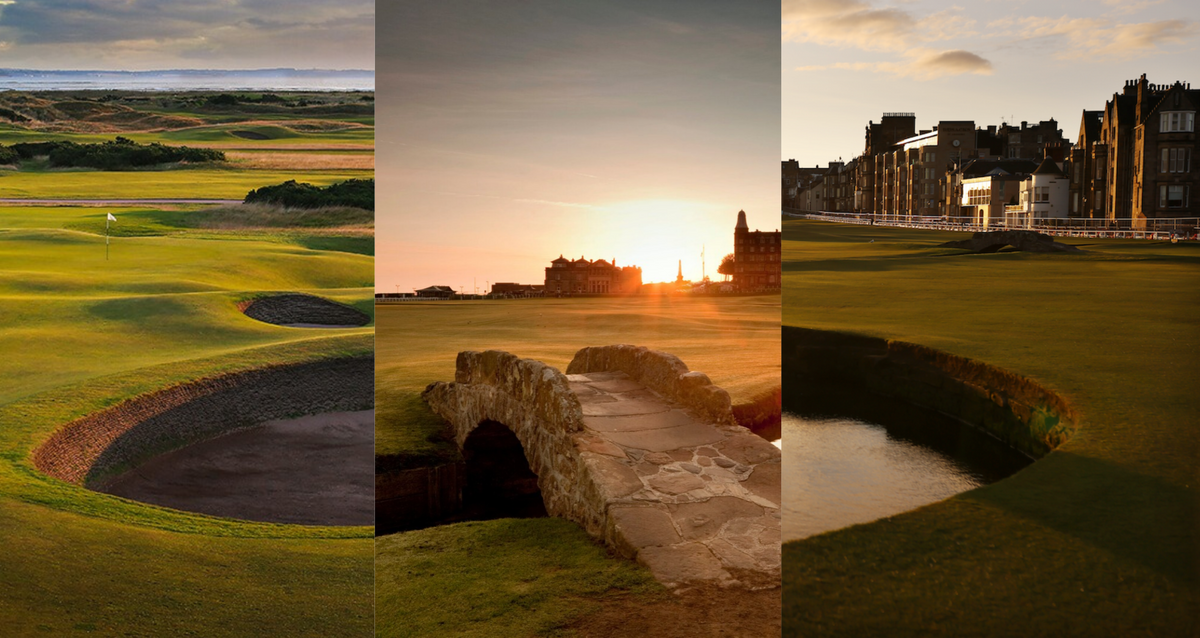
Every Sunday the Old Course closes to golf and opens to everyone else. Dogs, prams, students, pilgrims and people who have never held a club walk the fairways that cost £320 a round on Saturday. It is free, it has been happening for centuries, and it is the best thing to do in St Andrews.
At ten o'clock on a Sunday morning the first tee of the Old Course, which on any other day of the week is the most anxious hundred square yards in golf, has a labrador on it. Behind the labrador is a woman with a pram, a couple in walking boots consulting a map, three students in red gowns cutting across toward the beach, and an American in a cashmere jumper standing very still with his hands in his pockets, looking down the first fairway as if he has arrived at church. Nobody has a club. Nobody will, until Monday. For one day a week, and for as long as anyone can remember, the most famous golf course in the world is closed to golf and open to the town, and the town walks on it.
There is nowhere else this happens. Augusta lets nobody in; Pebble Beach charges you to look. The Old Course is a public park on Sundays because it is, and always has been, public land: the links belong to the town of St Andrews, held in common, and the townspeople have grazed, walked, dried washing and played on them since the game was invented here. The Sunday closure is the oldest expression of that. Old Tom Morris, who kept the greens for forty years and is buried in the cathedral grounds at the other end of town, is supposed to have said that the course needed a rest even if the golfers did not, and the Links has kept his Sabbath ever since, with two exceptions a year for the Open when it comes and the Dunhill Links in October.

The walk
Start where the golfers start, at the first tee below the R&A clubhouse, and walk out. The first and eighteenth share one enormous fairway, so wide that you could land a plane on it, and after fifty yards you reach the Swilcan Burn and the small stone bridge that carries the eighteenth fairway over it. The bridge is somewhere between five and seven hundred years old, was built for shepherds rather than golfers, and is the most photographed object in the game; on a Sunday you can stand on it for as long as you like, which on a Saturday you cannot. Then keep going. The course runs out along the shore with the West Sands on your right and the Eden estuary ahead, the holes going out on the left and coming back on the right, sharing the huge double greens that are the Old Course's strangest feature: seven of them, each serving two holes, so that a putt on the fifth may run past a flag for the thirteenth.
It takes an hour to walk out to the far end, the loop of holes seven to eleven by the estuary, and an hour to come back on the other side. You can do it in trainers; the ground is firm, sandy links turf that drains in minutes. You can bring the dog, on a lead. You can picnic, though the wind will have opinions. And you can stand in the places you have seen on television for thirty years and discover that they are smaller, closer together and stranger than the camera makes them: Hell bunker on the fourteenth, a pit you could lose a car in; the Road Hole bunker at the seventeenth green, a sink of sand the size of a bath with the green falling away into it, which you can walk down into and understand, at last, why grown men weep there; and the road itself, and the wall, and the hotel the golfers hit their drives over.
"For one day a week the most famous golf course in the world is closed to golf and open to the town."

Who is out there
Everyone. That is the point. Families from the housing estates behind the course, for whom it is the park. Students with hangovers walking off Saturday. Dog-walkers, who have the fairways from first light and know every bunker by name. Golfers who played on Saturday and want to see, without the fear, where their ball went. Couples who have driven from Edinburgh. Photographers at the bridge. And the pilgrims, who are easy to spot: they walk slowly, they touch things — the flagstick on the eighteenth, the stone of the bridge, the wall behind the Road Hole — and they tend to go quiet at the seventeenth. A caddie will tell you that the Sunday walk is the only time the course looks the way it did before the money came, which is to say a piece of rough coastal ground with holes cut in it, and people on it because it is there.
The detail people remember
Standing on the eighteenth tee looking home. On a Sunday you can walk to the exact spot from which every champion since 1873 has hit the last drive, and look up the widest fairway in golf toward the clubhouse, the Hamilton Grand, the spires, and the crowd that is not there. It is the view from the end of the Open, with nobody in it. Most people stand there longer than they meant to.
Doing it properly
Go early or go late. At nine the course is dog-walkers and mist; at four in winter it is gold. The middle of a summer Sunday can have several hundred people on the first and eighteenth and almost nobody past the fourth, so keep walking. Stay off the greens, which are roped or signed and which the greenkeepers will defend; the fairways are yours, the putting surfaces are not. Do not bring a club and hit anything, however tempting the empty fairway: it is the one thing that is actually forbidden, and the starter can see you from his hut. Check the date: the Old Course is open for play on the Sunday of the Open and of the Dunhill Links (early October), and closed for a fortnight of winter maintenance, and the Links Trust publishes all of it. And when you have done the walk, cross the road to the R&A World Golf Museum, whose upstairs café looks back over the ground you have just covered, and understand what you were looking at.

Who it is for
Anyone in St Andrews on a Sunday, without exception. It is the one thing in the town that the golfer, the non-golfer, the child, the dog and the grandmother can do together, at the same pace, for nothing. It is also the best possible first morning of a golf trip, because it shows you the course before you have to play it, and the best possible last one, because it lets you walk back over what you did.
It is not on if the Open or the Dunhill is in town, and it is not a walk for someone who needs a path: the ground is uneven, the wind is real, and there is no shelter for two miles. Take a coat, whatever the sky says at the first tee.
A little history
Golf was being played on these links by the 1400s, when a king tried to ban it, and the course had eleven holes out and eleven back until 1764, when the first four were combined into two and the round became eighteen, which is why every course in the world has eighteen holes. The land itself was the town's common from the beginning; a charter of 1552 confirmed the townspeople's right to use the links for golf, football, drying linen and grazing rabbits, and that right survived a Victorian sale, a rabbit war and two centuries of argument until the St Andrews Links Act of 1974 put the courses in trust for the town for good. The Sunday closure has no statute behind it. It is simply what St Andrews has always done, and the Links Trust would sooner sell the clubhouse than end it.
What to do nearby
Breakfast first: the café at the R&A World Golf Museum, opposite the first tee. Read: The R&A World Golf Museum.
The pier walk at noon, at the other end of town. Read: The red gowns of St Andrews.
Sunday lunch afterward: 18 at Rusacks, looking back over the eighteenth; or Rufflets. Read: 18 at Rusacks · Rufflets.
The whole course, in its own words: Read: St Andrews Links, more than the home of golf.
The Sunday of the weekend: Read: A perfect weekend in St Andrews.
Know before you go
Where: The Old Course, St Andrews Links. Start at the first tee below the R&A clubhouse, at the end of Golf Place, or from the West Sands car park at the Bruce Embankment.
When: Every Sunday, dawn to dusk, except the Sunday of the Open (next: 18 July 2027) and the Dunhill Links (early October), and during winter maintenance closures — check standrews.org.uk.
Price: Free.
How long: Two hours for the full loop to the Eden estuary and back; forty minutes for the first, seventeenth and eighteenth alone.
Good to know: Dogs on leads. Stay off the greens. No golf. Firm, sandy ground — trainers are fine, boots are better in winter. No shelter on the course; take a coat. Public toilets at the Links clubhouse and the West Sands.
Best time: Nine in the morning in any month, or four in the afternoon from October to February, when the light comes in flat off the sea and the course is empty past the fourth.






Share:
The Byre Theatre, St Andrews: the cowshed that became the best small theatre in Scotland
What to pack for St Andrews and the Highlands