



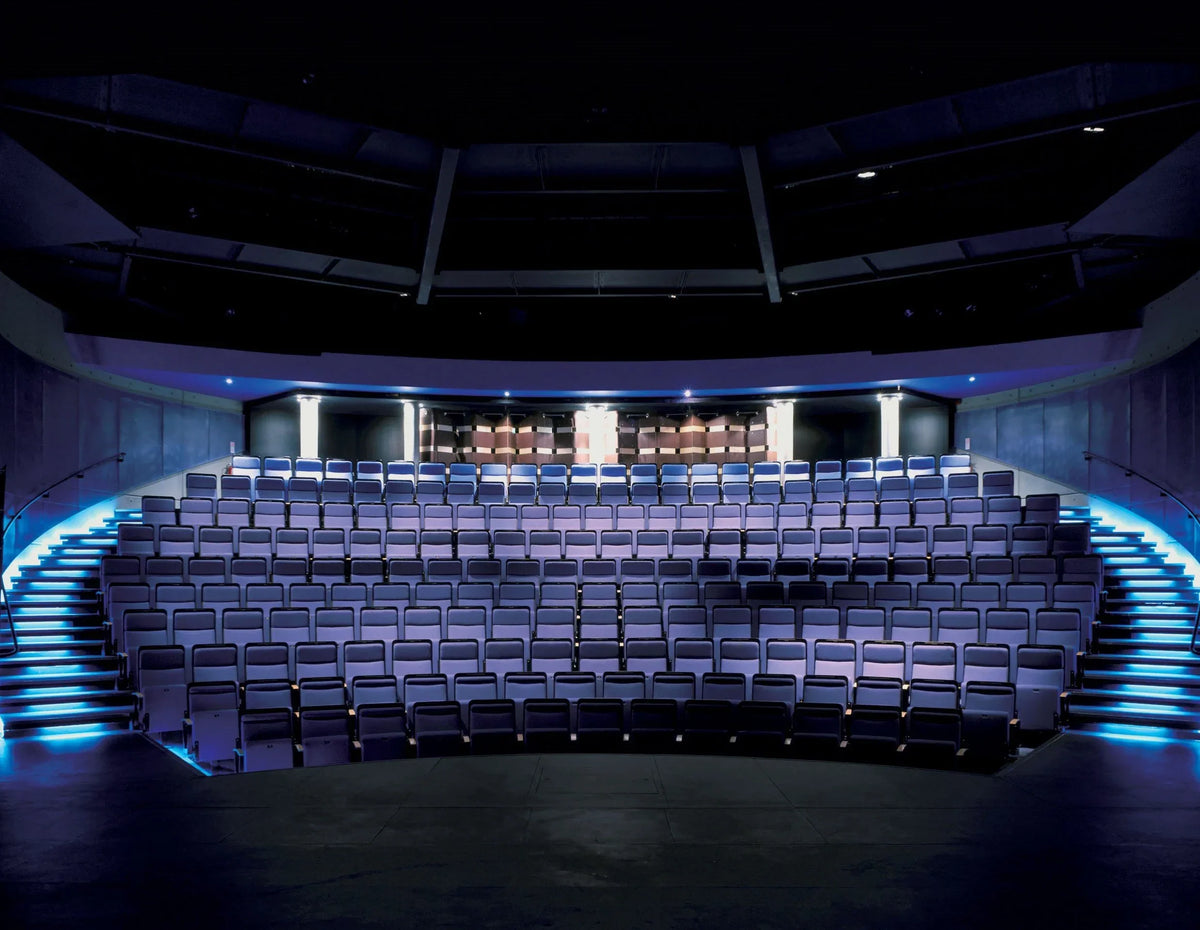
Ninety years ago a journalist and an actor cleaned out a byre on Abbey Street and put on a play. Today the Byre is a 216-seat theatre with a bar worth visiting on its own, a poetry festival the Times calls the country's best, and the reason a town of 17,000 people has a cultural life a city would envy.
Every visitor to St Andrews walks down South Street. Almost none of them turn off it at Abbey Street, the narrow lane that runs down toward the cathedral wall, and so almost none of them find the Byre, which is a pity, because it is the thing that makes the town more than a golf course with a university attached. It is a proper theatre — a main house of 216 seats with the rake and the sightlines of somewhere ten times the size, a studio for the smaller, stranger work, a cinema screen, and a bar and café on the ground floor that half the town treats as its living room — and it sits in a building of glass and pale stone that opened in 2001 with Sean Connery cutting the ribbon and Sondheim on the stage.
The name is not a whimsy. In 1933 a journalist called Alexander Paterson and an actor called Charles Marford, with a few members of Hope Park Church, took a disused cow byre on this site, swept it out, and started putting on plays. They called themselves the St Andrews Play Club; the first production, a courtroom drama called Murder Trial, opened in 1935. The cowshed is long gone, but the instinct — that a small town deserves serious theatre and will turn out for it — is exactly what the place still runs on.

Why go
Because there is something on. The Byre programmes the way a good small theatre should: touring drama from the Scottish companies and the London producers, a Christmas pantomime that sells out to three generations at once, comedy on the way to and from the Fringe, folk and classical music, dance, opera on screen, family shows on wet Saturday afternoons, a film programme in the studio, and the talks and lectures that come with having a university next door. On a random Tuesday in November there will be a play; on a Friday in March the whole building will be full of poets. For a visitor, that means an evening in St Andrews that is not dinner and a walk, which the town does not otherwise offer many of.
And because of the bar. The ground floor is a café by day and a bar by night, with a terrace onto the garden at the back, and it is one of the better places in town for a drink whether or not you have a ticket. Pre-theatre, it fills with people who know each other; after, with the cast. Students, retired professors, the golf crowd who wandered down from South Street and stayed — the Byre bar is the one room in St Andrews where the whole town turns up, and the coffee and the cake are good enough that people come at eleven in the morning too.

The building
The theatre you see is the third on the site. The cowshed was condemned in 1969 for housing; a modest replacement, modelled on London's Mermaid, opened in 1970 for £40,000 and did thirty years of hard service. Then in 2001 came the building that changed everything: a five-and-a-half-million-pound rebuild by the Dundee architects Nicoll Russell Studios, with the main auditorium named for Paterson and the studio for Lawrence Levy, the golf photographer whose foundation helped pay for it. It won awards. It has the intimacy of the old place and the lighting rig and the sound of a new one, and there is not a bad seat in the house.
It also very nearly closed. In 2013 the trust that ran it went into administration, the doors shut, and for a year the town had no theatre. The University of St Andrews took a twenty-five-year lease in 2014, with Fife Council and Creative Scotland behind it, and reopened it as a working theatre with the university's own programme folded in. The arrangement has been good for both: the Byre is busier than it was, and the university has the arts venue a university of its standing ought to have.
"The one room in St Andrews where the whole town turns up."
The detail people remember
StAnza. For a week every March the Byre becomes the centre of Scottish poetry: readings in the main house, the studio and the bar, poets from thirty countries, a festival founded in 1998 that the Times has called the country's leading poetry festival and the Guardian, more memorably, a flaming good one. If you are in St Andrews that week, go to something, even if you have not read a poem since school. The building hums.
Who it is for
Anyone staying more than a night who wants an evening that is not a restaurant. Couples on a weekend, who can book the pre-theatre supper and the play and walk back through the town at eleven. Families in the holidays, for the panto and the Saturday shows. Anyone in town in March. And the visitor who wants to see the university and the town do something together, which the Byre is the best place to watch.
It is not the West End, and it does not pretend to be: the touring shows are the good mid-scale ones, not the blockbusters, and the tribute nights are tribute nights. Check what is on before you build an evening around it. And parking on Abbey Street is a fiction; walk, or use the South Street car parks.

A little history
Alexander Brown Paterson wrote and directed for the Byre for forty years and is the reason it exists; the main house carries his initials. The Play Club became a professional repertory company in the 1940s, one of the smallest in Britain, and produced a remarkable number of actors who went on to larger stages. The 1970 building saw it through the lean decades; the 2001 building nearly sank it, as new buildings often do, and the university rescue in 2014 gave it a future. Ninety-three years after two men swept out a cowshed, it is still the only theatre in a Scottish town this size that a national critic would travel to review.
What to do nearby
The cathedral, two minutes down Abbey Street. Read: St Andrews Cathedral, where the story began.
Dinner before: the Adamson or Little Italy on South Street, five minutes; Forgan's on Market Street, seven. Read: Little Italy · Forgan's, St Andrews.
The pier walk on Sunday, at the foot of the same lane. Read: The red gowns of St Andrews. [when published]
Stay close: Hotel du Vin or the Kithmore, both a ten-minute walk. Read: Hotel du Vin, the wine hotel on the Scores. [when published]
An evening for the weekend: Read: A perfect weekend in St Andrews. [when published]
Know before you go
Address: The Byre Theatre, Abbey Street, St Andrews, Fife KY16 9LA — off South Street, two minutes from the cathedral.
From the Old Course: Fifteen minutes on foot, the length of the town; ten from Market Street.
Hours / season: Performances most evenings in season, matinees at weekends; the café-bar open daily from morning until after the show. StAnza in March; pantomime from early December into January. Check the programme.
Price: Tickets typically from around £12 for talks and film to around £30 for touring drama; panto from around £15. Concessions for students, under-16s and over-60s. Bar and café at pub prices.
How to book: See what's on and book, or the box office by phone or in person; the bar takes walk-ins.
Good to know: 216-seat main house, studio for smaller work, cinema screen. Step-free access and wheelchair spaces; hearing loop. Garden terrace at the back. No parking on Abbey Street — use South Street. Pre-theatre food in the café-bar.
Best time: StAnza week in March, or any evening in the panto run, when the whole town is in the bar at the interval.






Share:
The red gowns of St Andrews: why the students wear scarlet, and where to stand on a Sunday
Sunday on the Old Course: the day the most famous golf course in the world belongs to the town