



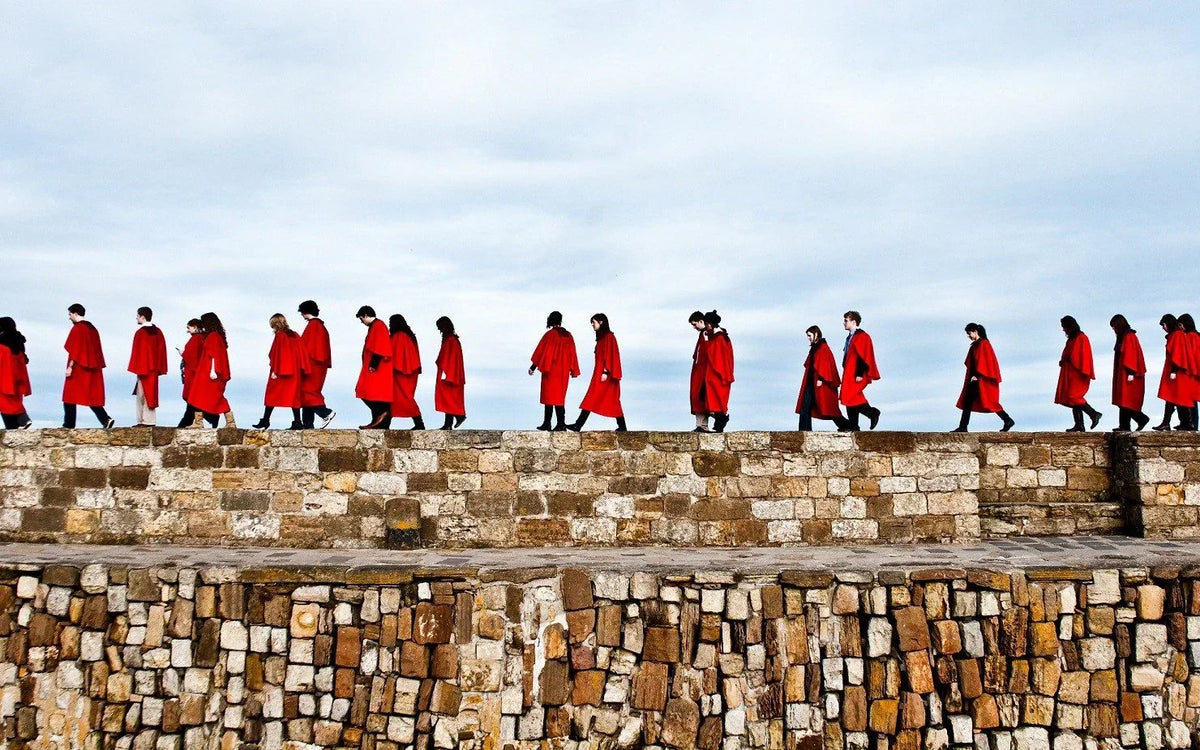
Every Sunday in term, after chapel, a line of students in scarlet gowns walks out along the harbour pier and back along the top of it, as they have for two hundred years. It is the most photographed thing in town after the Swilcan Bridge, and almost nobody watching knows what they are looking at.
Stand at the foot of the cathedral on a Sunday around noon, between September and May, and you will see it: a stream of red coming down the Pends and along the harbour, gowns blowing, and then a single file of students walking out along the stone pier to the end, turning, and coming back along the high wall on top with the North Sea on one side and a drop on the other. It takes twenty minutes. There is no announcement and no ticket. It has been happening, in one form or another, since a night in January 1800 when a nineteen-year-old student swam out to a wreck, and it is the clearest sign a visitor gets that St Andrews is not only a golf town but the oldest university town in Scotland, with 600 years of its own strange habits.
The gowns are the key to all of it. Once you know how to read them, you can tell a first-year from a finalist at fifty yards, and the whole town starts to make more sense.

Why the gowns are red
The university was founded in 1413, and by the 1670s a visitor was already noting that the younger students wore scarlet in term. The official reason, recorded by a royal commission in 1695, was moral: students were to wear red gowns so that vice and wandering would be discouraged, which is to say that a young man in a scarlet cloak could be seen going into a tavern from the other end of Market Street. The gown has changed a little since — sleeves and a velvet yoke were added after the students petitioned for them in 1838, and in 1963 someone specified the exact shade, British Colour Council Signal Red 210 — but the idea has not. It is a uniform that makes you visible, in a town small enough that visibility is a form of belonging.
Divinity students at St Mary's College are the exception. They wear black, with a purple saltire on the collar, and they look like a different order of thing walking among the scarlet, which is roughly the point.
How to read a gown
The gown is worn differently each year, and the code is exact. A first-year wears it properly, high on both shoulders, the way it was designed. In second year it slips down a little. In third year it comes off one shoulder entirely: the left for a student of arts, the right for a scientist, so that you can tell not only how far through they are but what they read. By fourth year it has slid off both shoulders and hangs from the crooks of the elbows, worn low and slightly carelessly by people who have earned the right. The way a gown sits is the most legible thing about a student in St Andrews, and they are all fluent in it; a first-year with a gown on one shoulder will be corrected, kindly, by the end of the week.

The pier walk
The walk itself begins at St Salvator's Chapel on North Street, where the university's Sunday service ends a little before noon. From there the gowns come east along North Street, down the Pends and out to the harbour, then along the pier — the long stone arm that shelters the fishing boats — to the very end, and back along the raised wall on top. The wall is narrow and there is no rail. That is part of it.
The origin is a rescue. On 5 January 1800, in a storm, a small ship called the Janet of Macduff went aground on the rocks east of the harbour with five men on board and no lifeboat in the town. A student named John Honey, nineteen years old, stripped, tied a rope around his waist, swam out to the wreck and brought the crew in one at a time, six trips through the surf, before he collapsed on the beach. He was given the freedom of four towns, became a minister, and died at thirty-two, his chest never having recovered from a mast that fell on him on the last trip. The pier walk is said to commemorate him, and every 30 April the students walk it again by candlelight, in a procession called the Gaudie, and throw a wreath into the sea where he went in.
"It is a uniform that makes you visible, in a town small enough that visibility is a form of belonging."
Where to stand
The best view is from the top of the cathedral end of the harbour, by the old sea wall below St Rule's Tower, looking along the pier with the East Sands beyond. Arrive by half past eleven, before the gowns do; by the time they reach the pier the wall fills with people holding phones. If you want to see them close, stand at the landward end of the pier itself, where the line turns. Do not walk out among them: it is their walk, not a performance, and they are gracious about visitors precisely because most visitors keep to the edge.
The busiest Sunday of the year is the one at the end of Orientation Week in September, when the whole first year does it together and the pier is red from end to end. The quietest are the wet Sundays in February, when a dozen turn up and the sea comes over the wall, and which, if you are honest, are the better ones to watch.
The rest of the calendar
The gowns come out for the other traditions too. In October, Raisin Weekend, when third- and fourth-years who have adopted first-years as their academic children dress them up and lead them, on the Monday morning, into St Salvator's Quad for a foam fight that the town has learned to walk around. At dawn on 1 May, the May Dip, when the students run into the North Sea from the East Sands to wash off the year's bad luck, which for most of them means having stepped on the initials PH set into the cobbles outside St Salvator's, where Patrick Hamilton was burned for heresy in 1528 and is said to have cursed the degree of anyone who treads there. And in June, graduation, when the red gowns are worn for the last time down the aisle of the Younger Hall and then, by tradition, given to the next generation.

Who it is for
Anyone in town on a Sunday in term who wants to see the university rather than read about it. Parents of prospective students, for whom it answers most of their questions. Photographers, who will get the picture of the trip. And the visitor who has done the golf and the cathedral and wants the thing the town does for itself, not for them.
It is not on in the long vacation, from June to early September, when the students are gone and the town is a different place; check the university's term dates before you plan a weekend around it.
A little history
St Andrews is the oldest university in Scotland and the third oldest in the English-speaking world, after Oxford and Cambridge, founded in 1413 by a papal bull from an antipope in Avignon, which tells you something about the century. For most of its life it was small, poor and clerical; the red gown was a way of keeping its students in order in a town that also had a cathedral, a castle, an archbishop and a good many taverns. It nearly closed in the nineteenth century. It is now one of the best universities in Britain, a third of its students come from outside the UK, and for nine months of the year it makes up a third of the town's population — which is why, on a Sunday in November, you will see more scarlet on Market Street than tartan.
What to do nearby
The cathedral and St Rule's Tower, where you are standing. Read: St Andrews Cathedral, where the story began.
Coffee afterward at Northpoint on North Street, opposite the chapel the walk started from.
The East Sands, at the far end of the pier, and the coastal path beyond.
Sunday lunch: Read: Rufflets, a country-house retreat on the edge of town.
Make it the Sunday of the weekend: Read: A perfect weekend in St Andrews. [when published]
Know before you go
Where: St Andrews harbour and pier, at the foot of the cathedral; reached down the Pends from South Street or along the Shorehead from the East Sands.
From the Old Course: Twenty minutes on foot, the length of the town.
When: Sundays in term, roughly mid-September to late May, from about 11.45am when chapel ends. The end-of-Orientation Sunday in September is the biggest; the Gaudie is on the evening of 30 April.
Price: Free.
How to see it: Be at the harbour wall below the cathedral by 11.30am. No booking, no ticket, no announcement.
Good to know: The pier wall is unfenced and the sea comes over it in weather; stay on the harbour side. Check the university's term dates — nothing happens in the summer vacation. The students are not performing; watch from the edge.
Best time: A clear cold Sunday in October or late February, when the light is low and the gowns are the only colour on the coast.






Share:
The Byre Theatre, St Andrews: the cowshed that became the best small theatre in Scotland